October 4, 2026
Gross-to-Net Without the Distributor Mythology
A practical gross-to-net walkthrough for mid-market CPG brands selling through UNFI or KeHE, and what you actually keep from each invoice.

Landing UNFI or KeHE feels like you made it. Door counts go up, and the sales team wants to celebrate. Then the remittance arrives, and the check is a fraction of what you invoiced.
That gap has a name, and it usually starts in the books, not with bad luck. Gross-to-net is the path from what you invoice a distributor down to what you keep. The difference is made up of promotional discounts, chargebacks, fees, shortages, and other deductions.
Most founders I talk to treat distributor deductions as something unfair and noisy that happens to them. They still use gross revenue as the scoreboard. Meanwhile the P&L never shows how you got from the invoice to the cash that hit the bank.
At Teicor we sit inside CPG brands as fractional CFOs and accounting operators. We aren't trying to sell you a portal scraper. We want gross-to-net readable on the books, so you can decide what's real trade, what is junk, and what to dispute before the window closes.
When you ship through a national distributor, the invoice is only the first step. A lot happens between the cases leaving your warehouse and the cash landing in your account. Along the way, the distributor takes promotional discounts, manufacturer chargebacks, shortages, damages, admin fees, freight clips, and payment-term adjustments out of what you billed. Some of that was planned. A lot of it was not.
If you only watch top-line shipments, you can look like a breakout brand while the business underneath gets thinner every quarter. The fix starts with one boring habit: map every step from gross sales down to net, on a monthly cadence, against a model you believe. This works the same way as contribution margin after ads, CAC, churn, and shipping on the DTC side, where the top line only tells you part of the story.
Manufacturer chargebacks are where a lot of founders get surprised.
You agree to a "10% MCB." You do the napkin math on your case price to the distributor. As a simple example, if you sell a case at $30, you budget $3.
Distributors usually don't calculate that way. They often apply the percent against their wholesale price to the retailer, which already includes their markup. You end up funding a discount on their margin, not just yours. Over a full promo calendar, that gap turns into margin you never planned to give away.
The same example is written out on its own in why trade deductions from a 10% MCB are not 10% of the case price.
Off-invoice windows work the same way. You cut the case price for a date range so the deal can hit the shelf. A smart distributor can forward-buy: load up at the promo price, then sell into retailers later at full wholesale. Your volume spikes in the window, reorders fall off a cliff after, and a big share of your annual cases quietly ran at the discounted rate.
That makes cash lumpy, which is the same timing squeeze we wrote about in Q4 load-in cash. It also makes production planning harder, since the order pattern stops reflecting real demand (our inventory strategy post goes deeper on that side), and net margin flattens along the way.
None of that means you should stop promoting. It means you price and track the promotion as if the math will be read by someone who knows this game better than you do.
Trade spend is often the biggest check on an emerging brand's P&L. Founders assume those dollars buy trial and a lower shelf price.
A good share of those dollars never reach the shopper at all. Fees and distributor margin absorb them instead.
Call it working vs non-working, or call it "dollars that moved a unit" vs "dollars that paid someone's ops." Temporary price reductions and scan-backs that fire at the register are the first kind. Admin fees, unresolved clips, double-markup chargebacks, and logistics gaps that get funded out of your promo budget are the second.
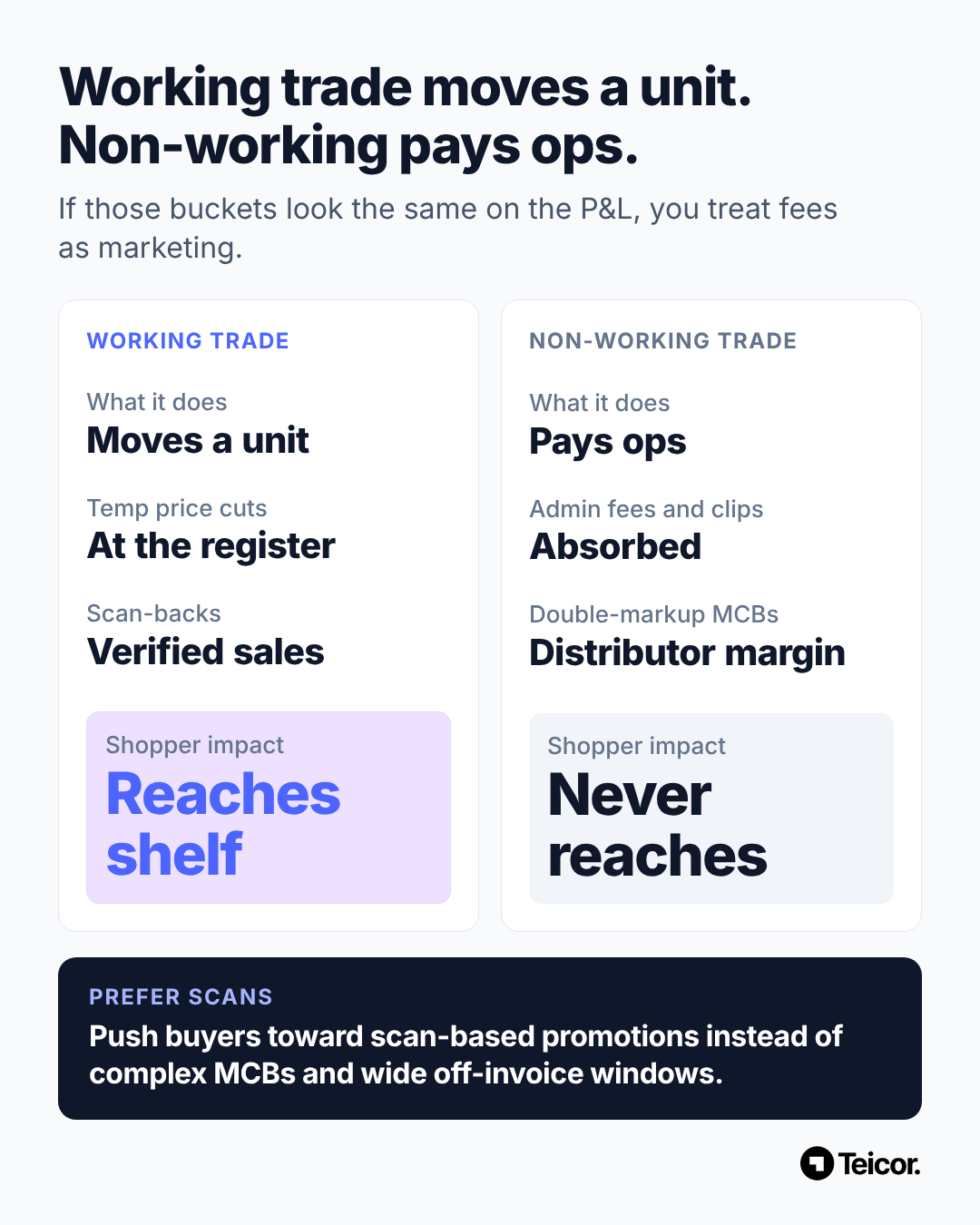
If those buckets look the same on your P&L, you'll keep paying for the second one and treating it as marketing.
Wherever you can, push buyers toward scan-based promotions instead of complex MCBs and wide off-invoice windows. Scans pay on verified register sales in an authorized window. That doesn't fix every deduction, but it stops a lot of forward-buy and double-markup leakage at the source.
Generic books dump everything into "Sales Discounts" or "Marketing," and once everything sits in one line, nobody can tell which deductions were planned.
A usable CPG chart of accounts separates at least:
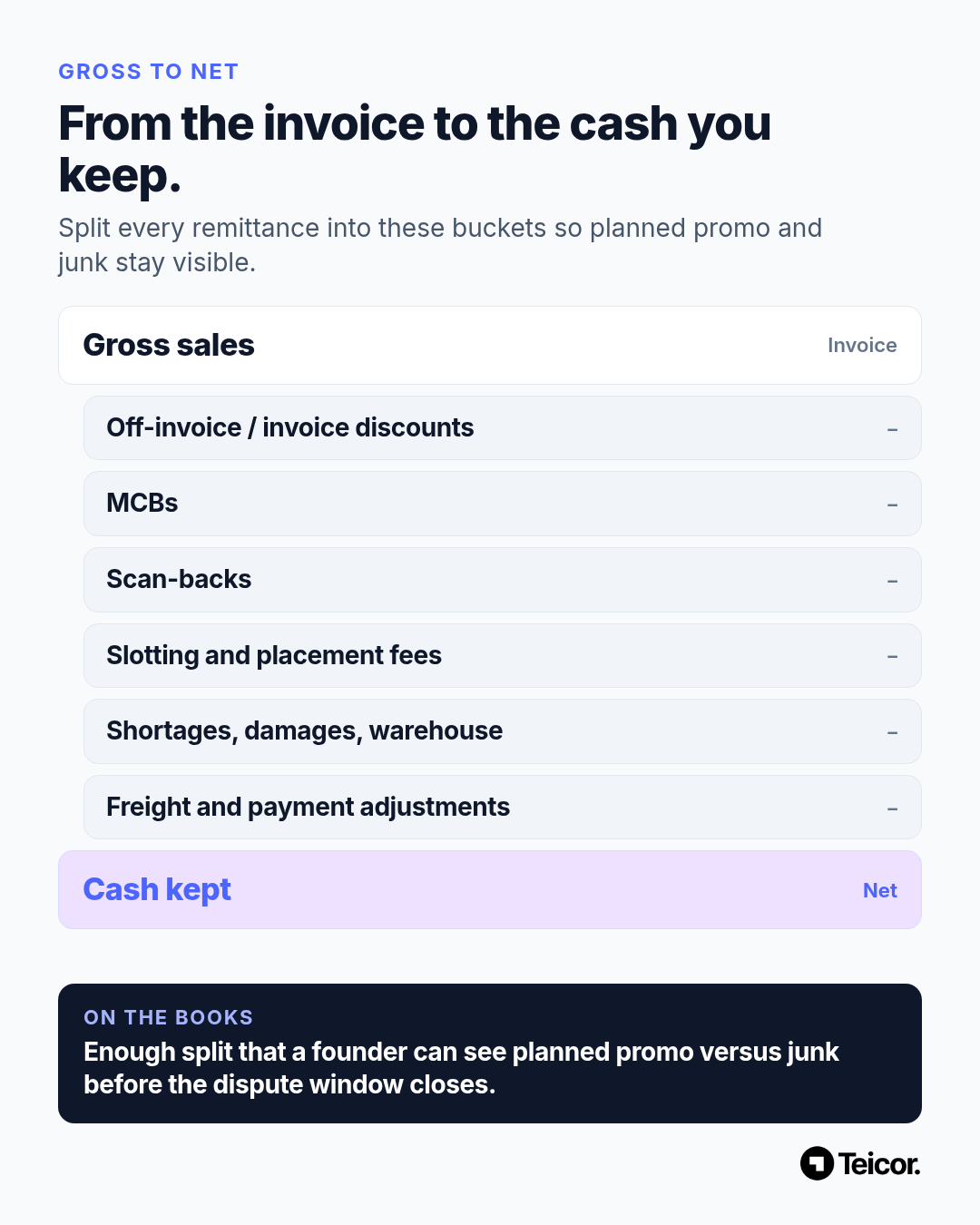
You don't need twenty sub-accounts on day one. You need enough split that a founder can answer: how much of last month's haircut was planned promo, and how much was junk?
The balance sheet has the same problem. Trade accruals and open AR mislead you when cash application is sloppy. A misapplied deduction can make it look like a customer still owes you when they don't. It can also hide open AR that's still real, or leave a liability sitting on the books because nobody cleared the accrual when the remittance hit.
Distributor remittances are messy on purpose. One payment covers a stack of invoices, with hundreds of reason codes sitting underneath. A generalist will force-match the cash or shove the leftover into an allowance bucket so the bank rec clears.
When that happens, the bank rec looks clean, but you lose the trail of which deductions were valid and which ones you could have disputed.
Line-item cash application means you tie every deduction code to an invoice, check it against the agreement or the promo calendar, and then either accept it into the right P&L bucket or park it for dispute. Do it weekly if volume is high, and at least monthly if it's not. Waiting until quarter-end guarantees you'll write off claims you could have challenged.
Sales and accounting have to talk. If Sales cuts a deal Accounting never sees, the remittance will always look like an ambush. If Accounting cleans deductions and Sales never hears which codes keep coming back, the next negotiation repeats the same leak.
Here is what we ask brands to do once distributor volume gets real:
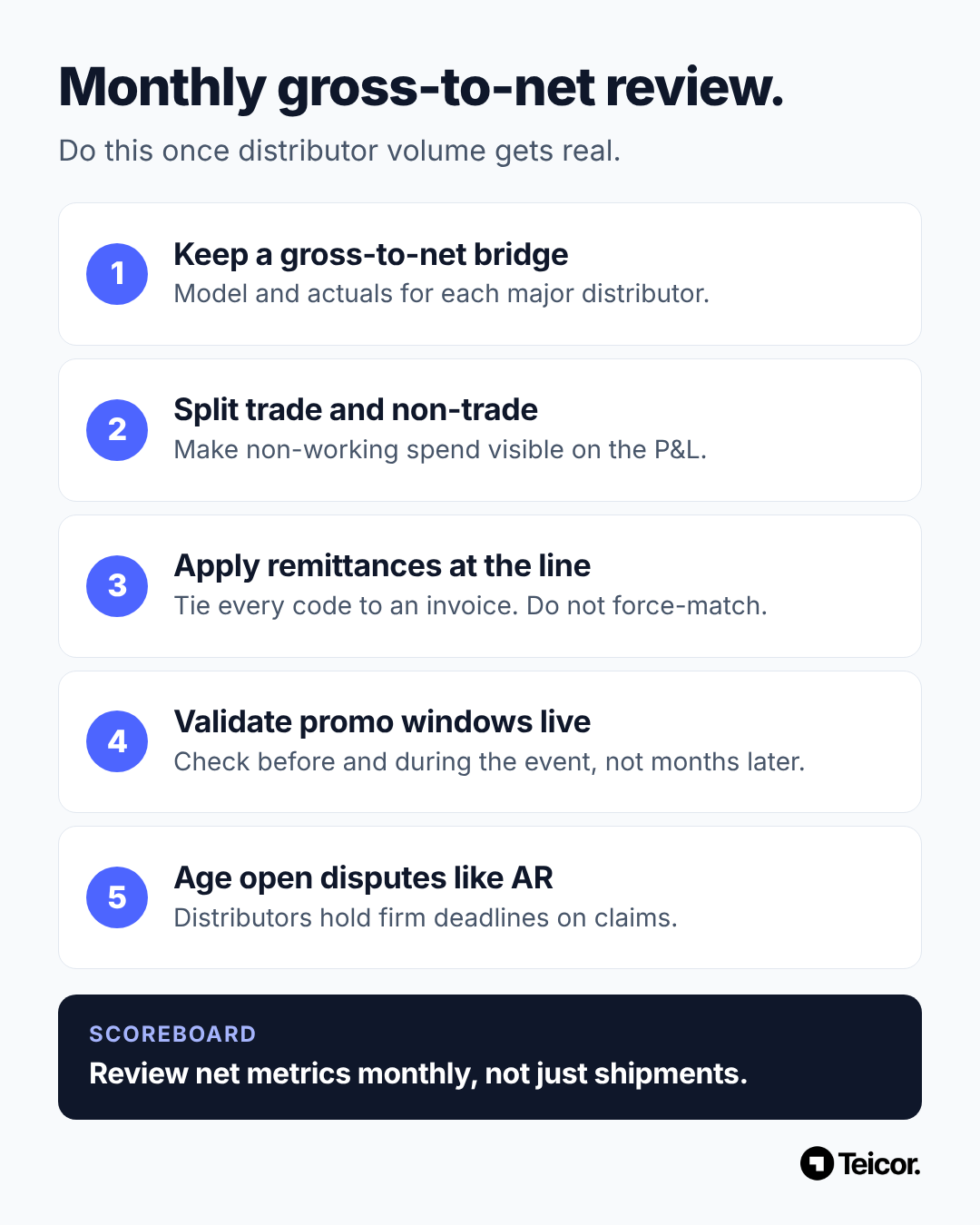
Tools can help when volume outgrows the team. They don't replace your judgment about what a code means, whether a claim matches the deal, or whether your chart of accounts even lets you see the leak. If that chart and the review habit aren't in place yet, the software mostly pushes the same confusion through the system faster.
Clean gross-to-net isn't only an investor exhibit. You use it when you decide whether a door is worth the promo calendar attached to it, whether you can afford the next co-man run, and whether AR and trade liabilities are going to throw off the cash plan.
A national distributor is a real asset when you can read the unit economics behind it. If you can't, deductions can drain cash faster than a slow sales month would.
If your last remittance is still hard to reconcile, I'd love to look at it with you. Reach out through our contact page and tell us which distributor you're working with and what promo window you have coming up next, and we can walk through one remittance together so you can see where the gap between invoice and cash came from. If it's easier to pick a time directly, you can book a call on my calendar.
Gross-to-net is the path from invoiced wholesale sales down to what you keep after discounts, chargebacks, fees, shortages, and other deductions. Gross is the starting point. Net is what the business earned on those cases.
Because many distributors apply the percent to their price to the retailer, which already includes their markup. You're discounting a higher base than the price you billed them.
Working trade is spend that changes what the shopper pays or sees in a way that can move a unit (for example a true temp price cut at the register). Non-working trade is spend absorbed as fees, clips, or distributor margin that never reaches the consumer. If you can't see both on the P&L, you can't manage them.
No. Start with COA buckets, a gross-to-net bridge, and weekly or monthly line-item cash application against agreements. Add tools when volume makes the portal work the bottleneck. Judgment and clean books come first.
Ready to gain clarity in your numbers and confidence in your decisions? Let’s build the financial foundation your business needs to operate smoothly and scale profitably.

Our latest news and trending topics